
LSA REED Fund: Tom Critchley
news / June 1, 2026
“Becoming a member of LSA, presenting at the conference and accessing the Research, Enterprise and Education Development Fund is best described as a PhD/ECR hack; the kindest, most supportive and generously funding group of researchers I have worked with.”
–Tom Critchley
See more on the project via –> Instagram <–
I have always believed in the situatedness of books; there are so many magnificent reads in the world, the books that stand out the most are the very ones that found you in that place at that time where the writing hangs everything together just right. Likewise, we also know that writing, particularly ethnographic, is also situated; it is shaped by the author’s positionality, subjectivity and environment from which it is produced. This has become obvious to me over the course of my PhD when collaborating, researching and writing about the Jamaican skateboarding and surfing community at The Freedom Skatepark in Bull Bay, Kingston. Undertaking my PhD in the School of Design at Goldsmiths University and visiting my collaborators in Bull Bay via sporadic fieldwork trips, I often felt a great disconnect between writing about the project in London and the day-to-day rhythms of The Freedom Skatepark. However, as my PhD neared completion and final hand-in approached, I jumped at the opportunity for a final fieldwork trip to The Freedom Skatepark that was funded by LSA and the Research, Enterprise and Education Development Fund.

[Figure 1: The Freedom Skatepark by Harry Gerrard]
A very affordable postgraduate student fee to become an LSA member allowed access to this grant opportunity of up to £5,000 for research and dissemination. After submitting an application that was modest in time to take, the turnaround was also quick and accompanied with constructive feedforward for my research plans. In my fund application, I detailed the primary motivations for my trip: to conduct final interviews with members of The Freedom Skatepark community, embrace the situatedness of writing and finish my thesis in the place where it is primarily set, and explore post-doctoral opportunities that can emerge from my ongoing research in Jamaica. I also very much appreciated the flexibility of this grant where I could organise the fieldwork trip around my broader PhD finishing plans, and by the turn of the year, I was scheduled to travel to Kingston, Jamaica for a 30-days for what would be the last trip before handing in my final thesis. Applying to the fund reflects my supportive experiences of association membership, and with accompanying funding perks, LSA membership is a must-have for any postgraduate or early career researcher in-and-around the broad field of leisure studies.

[Figure 2: My writing at Jamnesia]
The primary goal of the trip was to embrace the situatedness of writing by finishing the thesis in Bull Bay in hope the surrounding environment seeps into the words that I produced there. Towards this goal, there was only one place for me to stay during this trip: Jamnesia Surf Camp. Jamnesia Surf Camp was founded in the 1970s by Maggie and Billy Wilmot as a place to house visiting surfers to Jamaica and is the epicentre for the island’s surfing and skateboarding culture, and subsequently, my research on The Freedom Skatepark (that also happens to be 5-minutes down the road!). For 6-years I have been staying at Jamnesia where the Wilmot’s have done all they can to support my research ambitions. For this trip, the inclusion of a working space in my bungalow was the most caring of gestures that made me instantly feel at home and ready for writing. Nonetheless, I continued my pursuit of bringing Bull Bay into my thesis by strategising a writing schedule in key locations for the surfing and skateboarding history of Jamaica: a skatepark office, surf spot hotdesking, and reggae recording studios. This place-based writing was not only essential for my thesis, but also granted ease of access with my collaborators to iron out any inaccuracies, conduct last minute interviews, and share the core ideas of the research.
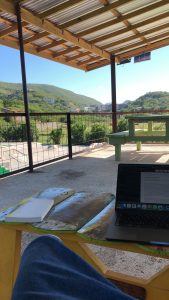
[Figure 3: writing at The Freedom Skatepark by author]
Key to this approach was my attempts to embody what Isabelle Stengers’ called “slowing down”, or in Jamaican patois, to “tek time.” This means embracing the daily rhythms of Bull Bay where I was not just taking my thesis into its fieldsite, but bringing my fieldsite into the thesis itself. In the thesis I described a methodological sensibility akin to Samuel Beckett’s Waiting for Godot as an open-ended and emergent approach to conducting research that seeks to foster the conditions for unplanned encounters and unexpected happenings. Accordingly, I found that thinking, writing, or often surfing and skateboarding, at these key locations in Bull Bay soon fostered conversations into formal interviews, impromptu focus groups, and discussions for future collaborations that aligned with my post-doctoral exploration plans; expectation is the greatest of the pleasures, but the unexpected is what teaches you the most!

[Figure 4: Freedom Skatepark surface wear reveals the impact of increased rainy seasons]
One such post-doctoral trajectory emerged from a shortcoming of my PhD research where I had not fully unpacked the environmental problematisations of social, yet concrete-built, projects such as The Freedom Skatepark. During my fieldwork visit, the recent Hurricane Melissa (2025) hung over much of the conversation in Bull Bay and shaped programming at The Freedom Skatepark, with skaters making regular trips to western Jamaica to support relief efforts and run skate classes. I found it particularly interesting when surfers described how apps designed to provide swell information became a way to inform their pre-Hurricane preparedness. Likewise, I closer examination of The Freedom Skatepark’s concrete surfaces provided an interesting lens to measure and feel the increase presence of hurricanes in the region since the skatepark’s construction as the once smoothed concrete began to roughen under environmental pressure. Together, and sitting on an intersection of Dan Johnston’s “skatepark trace and culture” methodology with Clifton Evers’ “polluted leisure” paradigm, my research interests at The Freedom Skatepark fostered through my most recent trip currently sit at exploring how leisure practices become a means to sense, feel, and experience climate change, and then into a medium for climate action. As such and continuing the tradition of LSA support in my research endeavours, I’ll be presenting these ideas at this year’s conference at Brunel London to develop them further through my ECR journey.
And, there was a one more unexpected research pleasure that came through this fieldwork trip that happened to align with Jamaica’s Reggae Month marked by the birthday of Bob Marley. Having developed quite a fondness to reggae music over the last 6-years as an inescapable soundtrack to my fieldwork tips to Jamaica, I did not miss the opportunity to celebrate this prophetic music of sufferation, spirituality and liberation. 5-minutes down the road from Jamnesia Surf Camp (the other direction than The Freedom Skatepark lays ‘Spot’ – one of Bull Bay’s well used surf spots, partly owing to the wooden veranda that sits over the beach area which provides great shade during Caribbean surf sessions. During Reggae Month this veranda turns into the stage for Wickie Wackie Music Festival, that for this year, hosted some real reggae royalty in Third World and Mystic Revealers, amongst others. But for me, it was the sound system party in-between and after the live acts that were an absolute honour to experience; witnessing legends such as Jah Observer and Uncle Ronnie play through four delicately placed full stacks was something I will never forget. And just by chance, I had taken a collected editions on the work of Stuart Hall with me to the island, leading to conversations with editor Julian Henriques about the possibilities of bringing Jamaican skateboarding and sound system culture together for new research-practice trajectories.

[Figure 5: Sound system stack. Photograph by Nicholas Bensley / Benz Sound]
As you can tell, February 2026 was a very epic month for me and my research. I still think I am coming back to earth from an incredible 30-days in Bull Bay, and as I have now submitted my PhD thesis for examination, I can take a step back to look at the work and feel some of the mystic energy that flowed through the surfing town and into the work. This was in thanks to Leisure Studies Association who have supported my research and work from the very first time I presented at LSA2023 in Bournemouth.
Becoming a member of LSA, presenting at the conference and accessing the Research, Enterprise and Education Development Fund is best described as a PhD/ECR hack; the kindest, most supportive and generously funding group of researchers I have worked with.
 [Figure 6: Reading Stuart Hall in Jamaica]
If you are thinking of joining LSA and/or presenting at the conference, please reach out and I would be more than happy to answer any questions you may have, and support you with this journey… you will not regret it!!
If you are interested in reading some of my research on Jamaican skate culture, please read my co-authored paper with Dr Andrea Buchetti ‘Skating the borderlands: a comparative study of popular leisure cultures in Mexico and Jamaica’
https://www.tandfonline.com/doi/full/10.1080/16078055.2026.2626425